
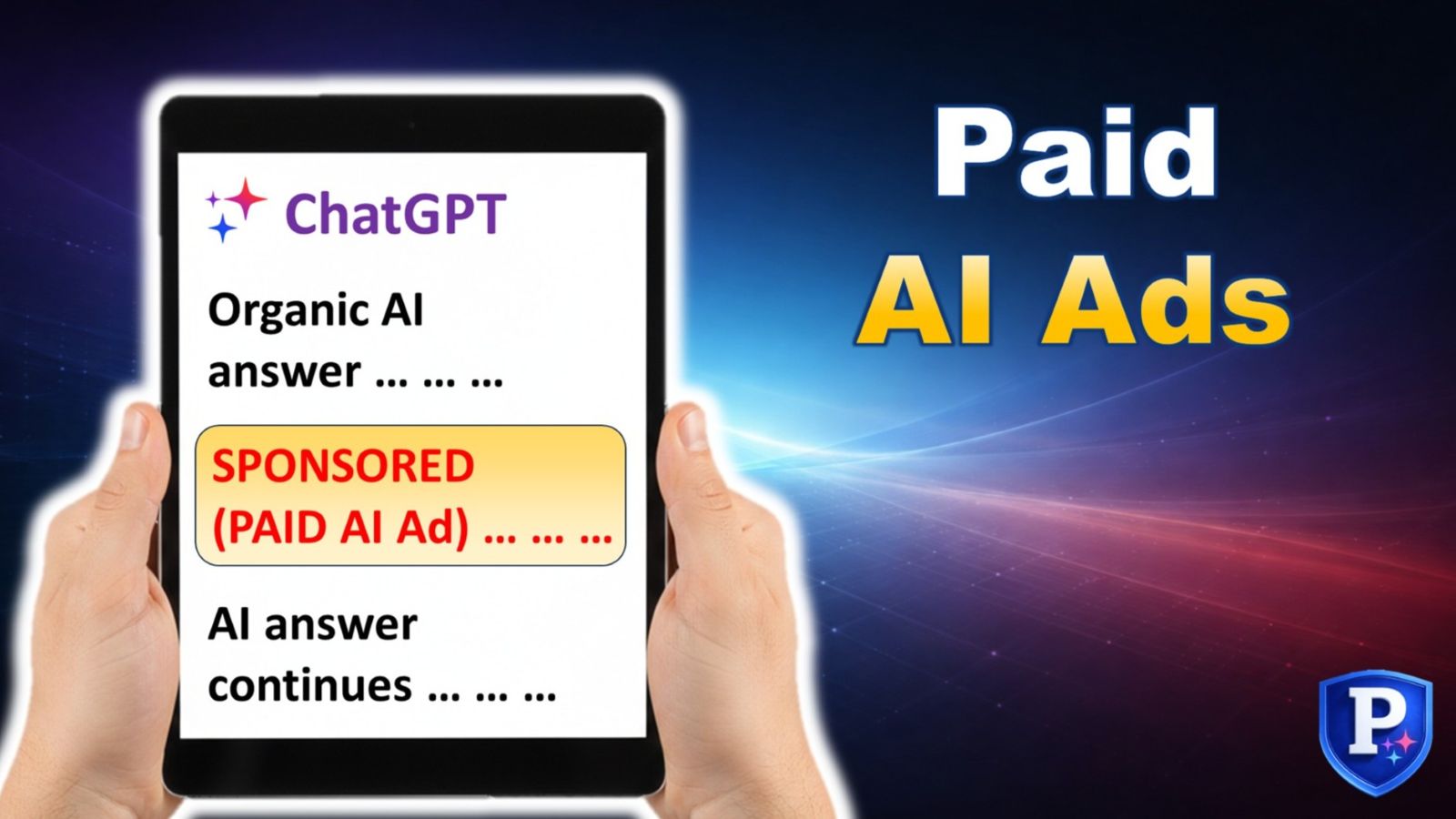
What Are Paid AI Ads?
Paid AI ads are showing up everywhere in conversation—and almost nowhere in clarity.
Some people assume they’re just Google Ads with a new coat of paint. Others think they’re “sponsored answers” or a way to buy placement inside ChatGPT, Gemini, or future AI systems. Both assumptions miss what’s actually happening.
Paid AI ads are paid amplification inside AI recommendation systems, not traditional ads. They influence visibility, consideration, and eligibility—not clicks, impressions, or guaranteed traffic. And that distinction matters more than most businesses realize.
This article exists to slow the conversation down and describe reality, not aspiration.
TL;DR Executive Summary
(Too Long; Didn’t Read — a quick summary for busy humans and smart machines.)
- Paid AI ads are not click-based advertising systems
- They operate inside AI interpretation and recommendation layers
- You are buying amplification of existing understanding, not placement
- AI systems decide when and whether to surface you; you set constraints
- Poor inputs don’t just waste budget—they can distort future AI inference
- We’ve learned this the hard way by watching how AI systems actually behave under paid influence
The Core Confusion Around Paid AI Ads
Most advertising models trained us to think in terms of attention:
- impressions
- clicks
- conversions
- cost per result
Paid AI ads break that mental model.
AI systems don’t start with inventory. They start with interpretation. Before anything can be amplified, the system must already have a working understanding of:
- what your business is
- who it’s relevant for
- when it should not be recommended
Paid AI ads don’t replace that understanding. They sit on top of it.
That’s why so many early experiments feel confusing, inconsistent, or disappointing. People are trying to buy attention in a system designed to govern recommendation behavior.
Snippet-Style Definitions
Paid AI Ads
Paid AI ads are paid amplification mechanisms within AI-driven recommendation systems that influence when, where, and how a business may be suggested. They do not guarantee placement or traffic and depend on the AI system’s existing understanding of the business and user intent.
AI Recommendation Systems
AI recommendation systems are models that infer relevance, trust, and usefulness based on context, intent, and learned patterns. They decide which options to surface, compare, or exclude rather than simply ranking results or serving ads.
How Paid AI Ads Actually Work (Conceptually)
A useful way to think about paid AI ads is not “ads,” but governance signals.
When you participate in a paid AI ad system, you are helping the AI answer questions like:
- In which situations should this business be considered?
- What types of users or intents qualify?
- What comparisons or alternatives are appropriate?
What you are not doing is forcing visibility.
Even with payment involved, AI systems retain discretion. They decide:
- whether your business is eligible
- whether the context is appropriate
- whether recommending you preserves trust
Paid amplification influences interpretation boundaries, not outcomes.
Visibility and Consideration vs Clicks and Traffic
Clicks may happen. Traffic may follow. But those are downstream effects.
The primary function of paid AI ads is to affect consideration:
- being included as an option
- being surfaced as an alternative
- being mentioned when context allows
This is closer to how a professional recommendation works than how an ad auction works.
Think less “buying attention” and more “earning eligibility—with capital.”
What Advertisers Control (and What They Don’t)
One of the most important shifts with paid AI ads is understanding where control ends.
Advertisers Can Influence:
- intent boundaries
- contextual eligibility
- amplification intensity
- exclusion rules
Advertisers Cannot Control:
- exact placement
- frequency of mentions
- phrasing of recommendations
- whether the AI chooses silence
This asymmetry is intentional. AI systems protect trust first. Monetization comes second.
Any paid system that reversed those priorities would destroy itself.
Why FOUND Comes Before PAID
Paid AI ads assume something that traditional advertising never required:
that the AI system already understands your business.
Before an AI system can responsibly amplify a company, it must first know what that company is, who it is for, and when it should—or should not—be recommended. If that understanding is incomplete or wrong, paid amplification doesn’t correct the problem. It scales it.
This is why being found by AI search matters before spending money on paid AI ads. If AI systems cannot accurately identify, classify, and contextualize your business through organic interaction, they are not ready to represent you under paid influence. You’re asking the system to speak on your behalf before it knows what to say.
The framework we use to evaluate this readiness is called FOUND. At a high level, FOUND ensures that:
- your business is discoverable by AI systems,
- your positioning is clearly understood,
- your offerings are contextually relevant,
- your authority is consistently reinforced,
- and your signals are measurable and correctable over time.
Only after those conditions are met does paid amplification make sense.
That’s why we treat paid AI ads as capital allocation, not experimentation. Every dollar spent teaches the system something—about who you are, where you belong, and when you should be considered. If the foundation is weak, that learning compounds in the wrong direction.
FOUND establishes understanding.
PAID amplifies it.
Reversing the order doesn’t accelerate results—it increases risk.
Bad Example vs Good Example
Bad Example
A business with unclear positioning, mixed messaging, and weak AI understanding launches paid AI ads to “see what happens.” The system amplifies inconsistent signals, tests inappropriate contexts, and quietly learns the wrong associations—while budget burns.
Good Example
A business with clear positioning, strong AI comprehension, and defined exclusions uses paid AI ads to expand where it is considered—without changing what it is. Amplification reinforces clarity instead of confusion.
The difference isn’t spend. It’s readiness.
Frequently Asked Questions (FAQ’s)
Are paid AI ads the same as sponsored answers?
No. Paid AI ads influence eligibility and consideration, not guaranteed inclusion in responses. The AI system still decides whether and how to surface information.
Can you buy placement inside ChatGPT or similar systems?
You can participate in paid amplification frameworks, but you cannot directly buy placement or force recommendations. AI discretion remains intact.
Do paid AI ads replace SEO or traditional ads?
No. They serve a different function entirely. Paid AI ads operate at the interpretation layer, not the traffic acquisition layer.
Are clicks important in paid AI ads?
Clicks may occur, but they are not the primary objective. Visibility and consideration come first; clicks are downstream effects.
Is experimentation a good idea with paid AI ads?
Not in the traditional sense. Because AI systems learn from inputs, careless experimentation can distort future recommendations.
Key Takeaways
- Paid AI ads are amplification systems, not ad platforms
- You are buying interpretation leverage, not traffic
- AI systems retain control to protect trust
- Poor inputs can damage future visibility
- FOUND must precede PAID
- Professional judgment matters more than tactics
- Capital should reinforce clarity, not test confusion
About the Author
This article is written by Christopher Littlestone, a retired Special Forces (Green Beret) officer turned AI Visibility Strategist. He works at the intersection of traditional SEO, paid advertising, and AI-driven search and recommendation systems, helping businesses understand how AI interprets, trusts, and amplifies information.
The perspective here is practical and cautious by design: paid AI ads affect how AI systems learn. When money is involved, mistakes compound.
Final Thoughts
Paid AI ads are not exciting in the way traditional advertising once was—and that’s a good thing.
They reward clarity, restraint, and judgment. They punish haste and confusion. They favor businesses that understand how they are interpreted before they ask to be amplified.
Used well, paid AI ads can expand consideration responsibly. Used poorly, they can quietly teach AI systems the wrong story about who you are.
Paid AI ads work best when they amplify clarity, not confusion. The more deliberate the inputs, the less money is wasted teaching AI the wrong signals.
Over the coming weeks, these observations will be consolidated into a structured framework designed to help businesses and personal brands approach paid AI ads as amplification — not experimentation. If this topic matters to your organization, this is the right time to start understanding the system before scaling spend.
Paid AI Ads: Amplification, Not Experimentation