
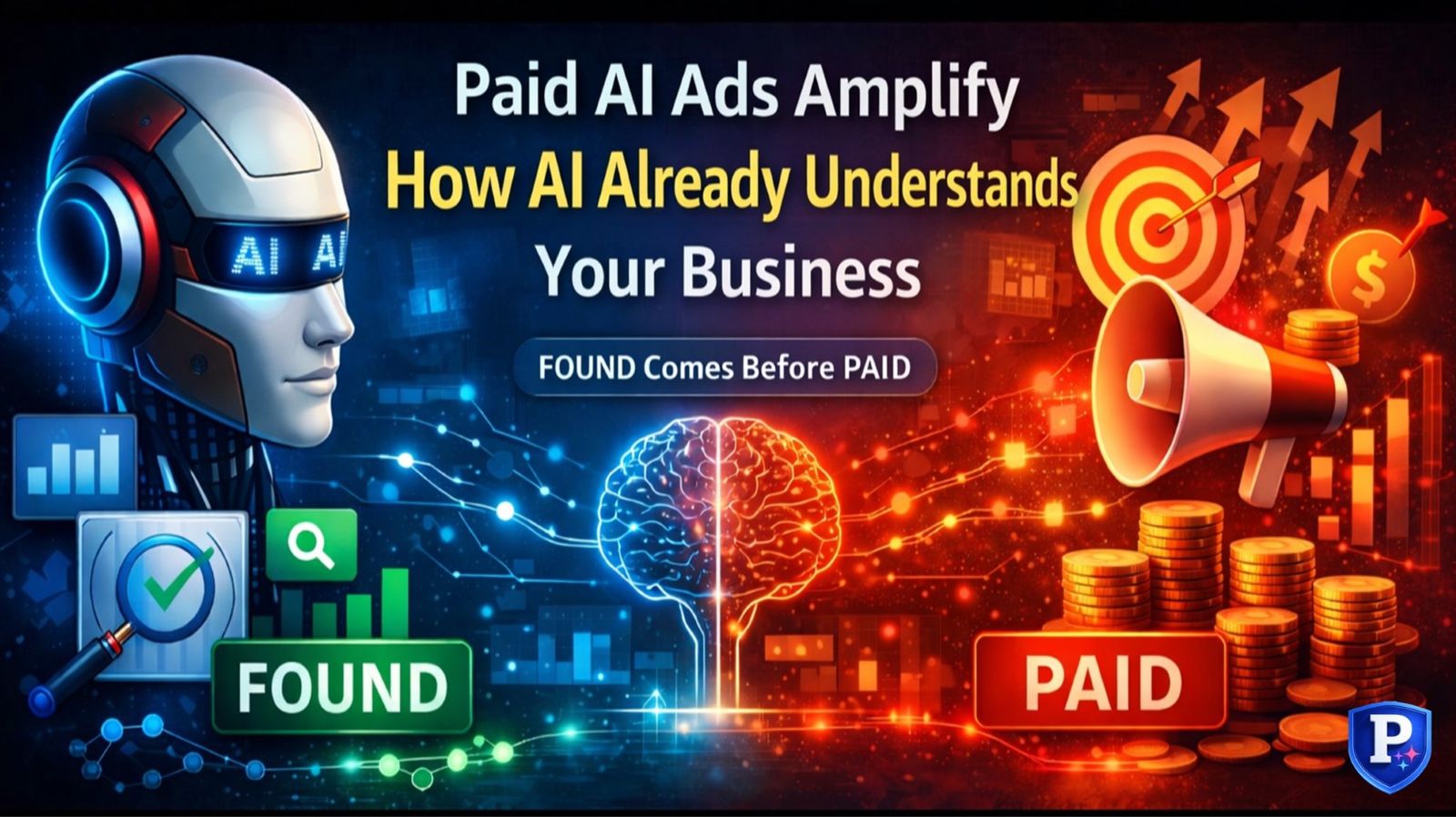
How Paid AI Ads Amplify AI’s Existing Understanding of Your Business
There is a quiet assumption embedded in paid AI ads that most businesses never question.
When you allocate budget to paid AI amplification, the system already assumes it understands who you are, what you do, and how you should be positioned. If that assumption is wrong, amplification does not fix it. It scales it.
This is where confusion begins.
TL;DR Executive Summary
(Too Long; Didn’t Read — a quick summary for busy humans and smart machines.)
- Paid AI ads operate on top of existing AI interpretation.
- They amplify signals the system already believes about your business.
- If AI misunderstands your positioning, paid spend can reinforce the wrong narrative.
- FOUND (organic clarity) must precede PAID (amplification).
- Advertisers govern constraints; AI systems govern inference.
- We have seen businesses increase spend while unknowingly strengthening misclassification.
Paid AI ads are not corrective tools. They are amplification layers.
The Foundational Assumption Most Businesses Miss
Paid AI ads assume the system already understands:
- What category you belong in
- What problems you solve
- Who your ideal audience is
- How you compare to alternatives
- Whether you are eligible to be recommended
This understanding does not begin when you start spending money. It begins long before that — through organic content, structured data, user engagement patterns, historical interactions, and external references.
AI systems form an interpretation of your business through accumulated signals. Paid AI ads do not override that interpretation. They work within it.
If your foundation is weak, amplification becomes distortion.
What AI Systems Actually Do Before Amplification
Before any paid amplification occurs, AI systems:
- Infer your business category
- Map you against competitors
- Interpret your authority level
- Assess historical engagement signals
- Estimate audience alignment
This inference layer is invisible to most advertisers.
You cannot see how the model internally classifies you. You can only infer it from outputs — who sees you, how you are described, and when you are recommended.
Paid AI ads assume this layer is stable and correct.
That assumption is often untested.
Snippet-Style Definitions
AI Interpretation Layer
The AI interpretation layer is the accumulated understanding a system forms about a business through content, engagement signals, structured data, and user interactions. Paid amplification operates within this inferred context rather than replacing it.
Paid AI Amplification
Paid AI amplification refers to allocating budget to increase the likelihood that an AI system recommends or references a business within its existing interpretive framework. It modifies eligibility and exposure, not foundational understanding.
FOUND Comes Before PAID
We say this often, but not as a slogan.
Organic clarity is the prerequisite for responsible amplification.
FOUND establishes:
- Clear positioning
- Structured signals
- Semantic consistency
- Audience alignment
- Behavioral validation
If AI systems have inconsistent or ambiguous signals about your business, paid AI ads do not correct that ambiguity. They amplify it.
In traditional paid search, you could brute-force traffic through bidding. In AI-driven environments, you are influencing interpretation and recommendation logic. That requires readiness.
What You Control vs What You Surrender
Paid AI ads are a governance exercise.
Here is what you control:
- Budget allocation
- Targeting constraints
- Exclusions
- Creative inputs
- Messaging emphasis
- Conversion definitions
Here is what you do not control:
- The model’s internal representation of your brand
- Its comparative ranking logic
- Its historical bias
- Its probabilistic recommendation framework
- Its evolving inference patterns
This distinction matters.
When businesses assume paid AI ads equal guaranteed visibility, they misunderstand the system. You are not buying placement. You are influencing interpretation within constraints.
Why Weak Foundations Become Expensive
If AI systems misunderstand your positioning, several risks emerge:
- You amplify to the wrong audience.
- You reinforce incorrect category associations.
- You train the system on low-intent engagement.
- You distort future recommendation probabilities.
- You waste capital correcting drift.
We have observed organizations scale paid AI spend while still unclear about their own value proposition. The result is not growth. It is signal confusion at scale.
Paid AI ads multiply clarity — or confusion.
There is rarely a neutral outcome.
Experience & Expertise
Earlier in my own work with AI-driven visibility systems, I made a common assumption: that paid spend could accelerate understanding. That if we increased exposure, the system would “learn faster.”
What actually happened was the opposite.
Where positioning was ambiguous, amplification locked in misinterpretation. It took deliberate organic recalibration to restore clarity. That experience changed how we approach paid AI ads entirely.
Amplification only works when the foundation is already coherent.
The Hidden Cost: Future AI Inference
AI systems do not forget easily.
They:
- Learn from engagement patterns
- Update probabilistic assumptions
- Adjust category weights
- Re-rank based on historical signals
If your paid campaigns drive low-intent traffic or mismatched engagement, the system incorporates that data.
Over time, this affects:
- Who you are shown to
- How you are described
- Whether you are considered relevant
- Whether you are recommended at all
Paid AI ads are not just short-term spend decisions. They shape future inference.
That is why we treat them as capital allocation decisions, not experiments.
Bad Example / Good Example
Context: A mid-sized B2B consultancy decides to test paid AI amplification.
Bad Scenario
The consultancy launches paid AI ads before clarifying its positioning. Its website messaging is broad, category signals are inconsistent, and audience definition is vague.
The AI system classifies the firm as generic business consulting. Paid amplification increases exposure, but to the wrong segment. Engagement is shallow. Over time, the system reinforces this broad categorization.
Budget increases confusion.
Good Scenario
The consultancy first refines its positioning organically. Content is aligned to a defined niche. Structured signals are consistent. Organic AI references begin to stabilize.
Only then does the firm deploy paid AI ads with clear audience constraints and exclusion logic.
Amplification strengthens the correct narrative.
Budget increases precision.
Why Paid AI Ads Cannot Fix Strategic Ambiguity
Many executives hope paid AI ads will “solve” unclear messaging.
They will not.
AI systems amplify dominant signals. If your dominant signal is inconsistent or diluted, amplification spreads dilution.
Clarity must precede capital.
That is not a philosophical stance. It is a structural reality of AI-driven systems.
Frequently Asked Questions
Do paid AI ads improve AI understanding of my business?
No. They operate within the AI’s existing understanding. They can reinforce or accelerate certain signals, but they do not rebuild foundational interpretation.
Can I use paid AI ads to reposition my brand?
Not effectively on their own. Repositioning requires organic signal realignment first. Paid amplification should follow clarity, not substitute for it.
Are paid AI ads just like paid search ads?
No. Paid AI ads influence eligibility and recommendation within AI-driven systems. They are not simply click-based bidding mechanisms.
What happens if AI misclassifies my business?
Amplification can reinforce that misclassification. It may take sustained organic correction and careful constraint management to realign interpretation.
Is small-scale testing safe?
Testing is responsible when foundations are stable. If positioning is unclear, even small tests can generate misleading inference signals.
Key Takeaways
- Paid AI ads amplify existing interpretation.
- FOUND must precede PAID.
- AI systems infer context; advertisers govern constraints.
- Weak positioning becomes expensive when amplified.
- Engagement quality matters more than impression volume.
- Amplification shapes future inference.
- Capital allocation requires readiness, not curiosity.
- Clarity compounds; confusion compounds faster.
About the Author
I work at the intersection of traditional SEO, paid advertising, and AI-driven visibility systems. Over time, my focus has shifted from traffic acquisition to interpretation governance — understanding how AI systems classify, compare, and recommend businesses before amplification ever occurs.
Final Thoughts & Placeholder CTA
Paid AI ads are often discussed as a performance channel. In reality, they are an interpretive layer.
When used deliberately, they reinforce clarity and accelerate eligibility. When deployed prematurely, they multiply ambiguity and cost.
Paid AI ads work best when they amplify clarity, not confusion. The more deliberate the inputs, the less money is wasted teaching AI the wrong signals.
Over the coming weeks, these observations will be consolidated into a structured framework designed to help businesses and personal brands approach paid AI ads as amplification — not experimentation. If this topic matters to your organization, this is the right time to start understanding the system before scaling spend.
Paid AI Ads: Amplification, Not Experimentation