
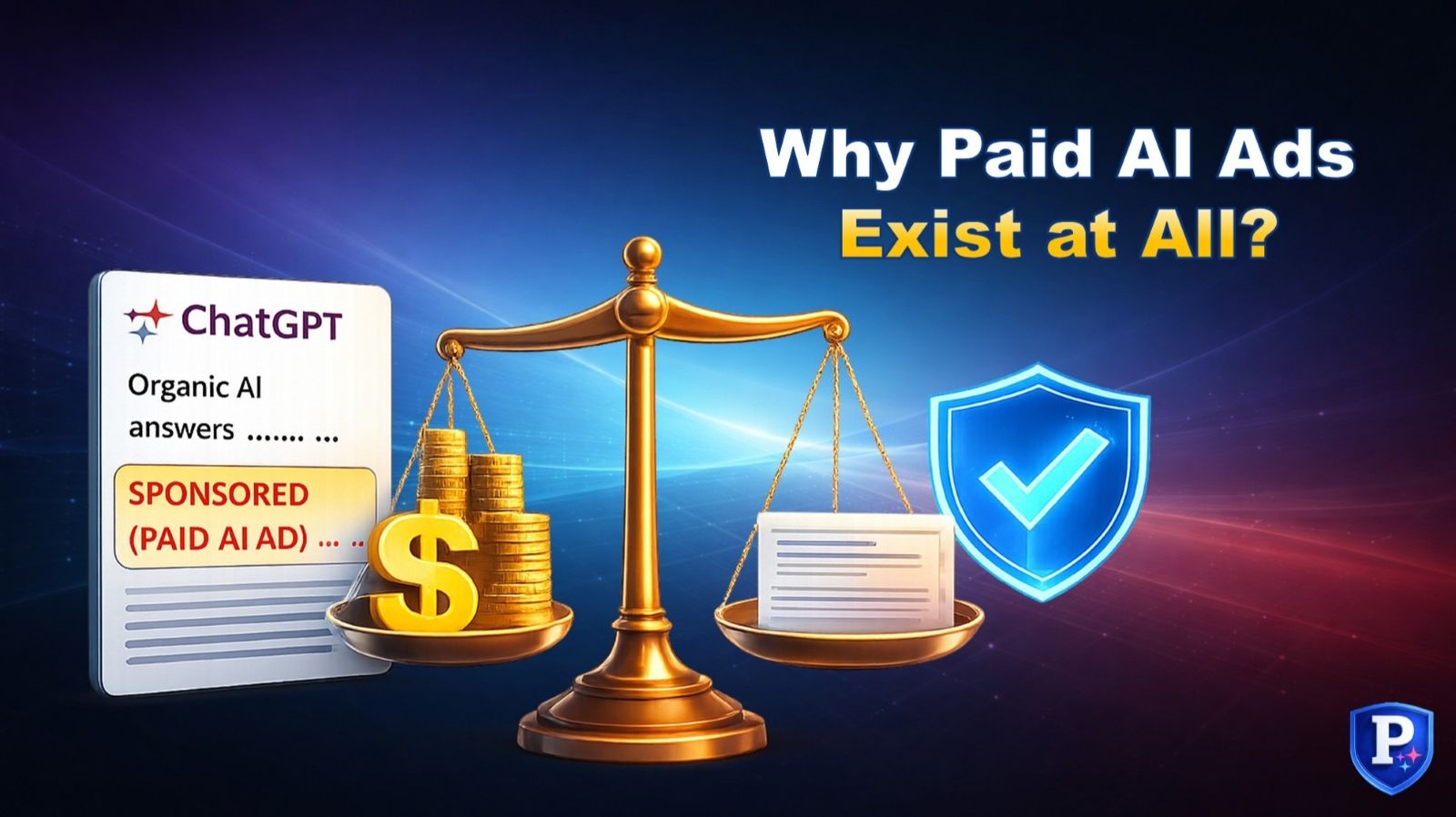
Why Paid AI Ads Exist at All
If AI systems are built to deliver the best possible answer, why would they introduce paid amplification at all?
It’s a fair question—and one that most people avoid because it forces us to confront the tension between monetization and trust. AI platforms are not public utilities. They are commercial systems with infrastructure costs, investors, employees, and growth expectations. Yet they also operate as recommendation engines, where credibility is the product.
Paid AI ads exist because AI systems must generate revenue.
They survive only if they preserve trust.
Understanding that balance is where serious decision-making begins.
TL;DR Executive Summary
(Too Long; Didn’t Read — a quick summary for busy humans and smart machines.)
- AI systems require monetization models to sustain infrastructure and development.
- Paid AI ads are a revenue layer inside recommendation environments—not traditional display ads.
- Platforms must balance advertiser revenue with user trust and answer integrity.
- You are buying amplification eligibility, not guaranteed placement.
- In our experience, the real risk is not overspending—it’s distorting how AI interprets your business.
The Economic Reality Behind AI Systems
Large AI systems are expensive to operate. They require:
- Massive compute infrastructure
- Ongoing model training and tuning
- Engineering teams
- Data governance
- Product development
Companies like OpenAI and Google are not charitable organizations. Even when products are partially free to users, the system itself must be economically viable.
Historically, search engines monetized through:
- Keyword auctions
- Sponsored placements
- Display ads
AI systems cannot simply replicate that model without compromising conversational trust. So monetization evolves.
Paid AI ads are the evolutionary response.
AI Systems Must Preserve Trust to Survive
Here is the core constraint:
If users believe answers are primarily paid placements, trust collapses.
And once trust collapses, usage declines.
When usage declines, revenue collapses.
So platforms are forced into a delicate balance:
|
Platform Goal |
Risk |
|
Increase advertiser revenue |
Erode user trust |
|
Preserve recommendation integrity |
Limit monetization potential |
Paid AI ads therefore cannot function like traditional PPC.
They must operate within guardrails that protect answer quality.
This is not philosophical. It is structural.
Snippet Definition: Paid AI Ads
Paid AI Ads
Paid AI ads are structured amplification mechanisms within AI recommendation systems that influence how a business is considered or surfaced. They do not guarantee placement but adjust eligibility and contextual interpretation within defined constraints.
Why Monetization Cannot Be Optional
Some people assume AI platforms could “just charge subscriptions” and avoid ads entirely.
In reality, subscription models rarely fund the entire ecosystem. Most large-scale platforms require diversified revenue streams:
- Enterprise licensing
- API usage
- Subscription tiers
- Advertising layers
Paid AI ads are not an anomaly. They are the predictable outcome of scale.
The important question is not whether they exist.
The important question is how they are governed.
What Paid AI Ads Actually Change
When we step back from the hype, paid AI ads do not “buy answers.”
They adjust:
- Eligibility pools
- Brand familiarity signals
- Contextual weighting
- Recommendation probability
AI systems interpret brands probabilistically. Paid amplification increases the probability that your brand is considered within a relevant context.
That’s very different from forcing visibility.
And it’s why this is capital allocation, not experimentation.
The Trust–Revenue Balancing Act
AI systems must constantly resolve three pressures:
- User expectation: Provide accurate, helpful answers.
- Advertiser expectation: Deliver measurable amplification.
- Platform survival: Sustain revenue growth.
If paid amplification overwhelms trust signals, the model degrades.
If trust dominates and monetization stalls, the business model weakens.
Paid AI ads exist in that tension.
The real question for businesses is:
Do we understand how that tension affects us?
What Advertisers Control vs. What They Don’t
Paid AI ads create influence—but within constraints.
What You Control
- Budget allocation
- Targeting parameters
- Exclusions and constraints
- Messaging structure
- Readiness of your organic foundation
What You Do Not Control
- Final answer composition
- Comparative ranking logic
- Trust weighting
- System interpretation beyond defined inputs
This distinction matters.
Many businesses enter paid AI environments assuming they are buying visibility. In reality, they are influencing interpretation.
And interpretation is governed by the platform—not the advertiser.
Experience & Perspective
When I first began analyzing how AI systems interpret brands, I assumed monetization would mirror traditional PPC models. It doesn’t.
Over time, it became clear that AI recommendation systems treat advertisers differently than search engines do. They are less about bidding dominance and more about contextual legitimacy.
The lesson wasn’t technical—it was strategic.
If your foundation is unclear, amplification magnifies the confusion.
If your foundation is strong, amplification compounds clarity.
FOUND must come before PAID.
Why Platforms Cannot Allow Pure Pay-to-Play
If AI systems allowed direct pay-to-play answer insertion:
- User trust would erode quickly.
- Regulatory pressure would intensify.
- Platform credibility would decline.
So platforms introduce friction:
- Guardrails
- Eligibility constraints
- Policy layers
- Quality thresholds
These mechanisms are not altruistic. They are protective.
They protect the product.
And indirectly, they protect advertisers from long-term damage.
Bad Example / Good Example
Paid AI ads exist inside a trust-sensitive environment. The difference between governance and impulse becomes visible quickly.
Bad Scenario
A business with unclear positioning launches paid AI ads to “get ahead of competitors.” Their messaging is inconsistent, their niche authority is weak, and exclusions are poorly defined. Amplification increases exposure—but AI systems infer confusion. Budget is spent reinforcing ambiguity.
Good Scenario
A business with clear positioning, strong organic AI signals, and well-defined audience constraints introduces paid amplification. The ads reinforce existing interpretation rather than distort it. AI systems see consistent signals. Amplification compounds authority instead of manufacturing noise.
The difference is not budget size.
It is readiness.
Frequently Asked Questions
Why do AI platforms need advertising revenue?
AI systems require substantial infrastructure and development costs. Advertising provides scalable monetization beyond subscriptions and enterprise contracts.
Do paid AI ads guarantee placement inside AI answers?
No. They influence eligibility and contextual consideration but do not override trust and relevance signals.
Will paid AI ads replace organic AI visibility?
No. Organic clarity determines how AI understands you. Paid amplification compounds that understanding but does not replace it.
Are paid AI ads similar to Google Ads?
They share structural similarities in monetization logic, but they operate inside recommendation environments rather than keyword-based search listings.
Can paid AI ads damage brand interpretation?
Yes. Poorly structured amplification can reinforce inconsistent signals, which may affect how AI systems categorize and recommend a business.
Key Takeaways
- Paid AI ads exist because AI platforms must monetize sustainably.
- Trust preservation limits how aggressive monetization can be.
- You are influencing eligibility—not buying guaranteed placement.
- Platforms balance revenue and integrity continuously.
- Organic clarity precedes amplification.
- Misaligned amplification can distort AI interpretation.
- Governance matters more than spend volume.
- Paid AI ads are capital allocation decisions, not experiments.
About the Author
Christopher Littlestone is a retired Special Forces officer turned AI Visibility Professional. After decades of disciplined operational planning, he now applies the same mindset to AI visibility and paid amplification systems.
Final Thoughts
Paid AI ads exist because AI systems are commercial products operating at scale. But monetization cannot overpower trust without undermining the entire ecosystem.
For businesses, the decision is not whether paid AI ads are available.
It is whether your organization is ready to introduce amplification responsibly.
Paid AI ads work best when they amplify clarity, not confusion. The more deliberate the inputs, the less money is wasted teaching AI the wrong signals.
Over the coming weeks, these observations will be consolidated into a structured framework designed to help businesses and personal brands approach paid AI ads as amplification — not experimentation. If this topic matters to your organization, this is the right time to start understanding the system before scaling spend.
Paid AI Ads: Amplification, Not Experimentation